Back to blogEOR
Global EOR Services Guide: Your Path to Success in 2026
Jamie Haerewa Jan 27, 2026 12 min read
The world is expanding at lightning speed, and so are the opportunities—and challenges—of hiring across borders in 2026. Companies now navigate a maze of regulations, payroll hurdles, onboarding headaches, and hidden risks each time they enter a new market.
That’s where global eor services come in. At Agile, we’ve seen firsthand how these solutions help businesses hire talent anywhere, faster and safer, removing the roadblocks that slow global growth.
In this guide, I’ll walk you through what’s changing in the world of global EOR, what to expect in 2026, and how to turn complexity into a strategic advantage. We’ll cover EOR fundamentals, the latest trends, a practical step-by-step guide, compliance insights, technology shifts, and how to choose the right partner for your journey.
At Agile, we stay ahead of these pitfalls by using real-time monitoring and deep local expertise. For more on how we approach compliance and risk, see EOR compliance and risk management.
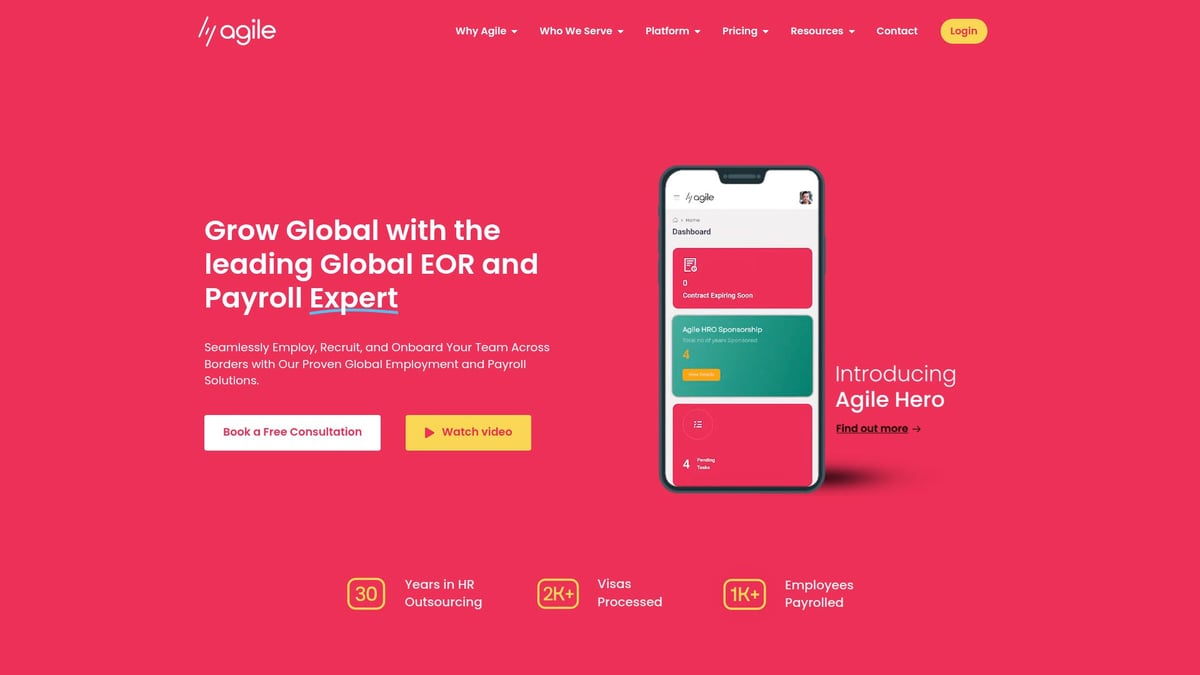 We bring deep expertise across 100+ countries, blending technology with high-touch support. Every expansion is guided by local compliance, fast onboarding, and a dedicated advisor who knows your business. Our transparent pricing means no surprises. We’re proud of our social impact, too, supporting education in Cambodia and earning industry awards for payroll and HR solutions.
We don’t just enable hiring—we help you build lasting teams worldwide.
We bring deep expertise across 100+ countries, blending technology with high-touch support. Every expansion is guided by local compliance, fast onboarding, and a dedicated advisor who knows your business. Our transparent pricing means no surprises. We’re proud of our social impact, too, supporting education in Cambodia and earning industry awards for payroll and HR solutions.
We don’t just enable hiring—we help you build lasting teams worldwide.
Understanding Global EOR Services: What, Why, and How
Opening up new markets is thrilling, but it can feel like navigating a maze. I’ve seen companies, from scrappy startups to global giants, hit the same barriers: local red tape, payroll headaches, and compliance risk. That’s where global eor services change the game.Defining Employer of Record (EOR)
An Employer of Record, or EOR, is a specialist partner that legally employs talent on your behalf in countries where you don’t have a local entity. This is not the same as a PEO, outsourcing, or traditional hiring. With global eor services, the EOR becomes the legal employer, handling payroll, tax, benefits, and HR compliance. For example, if you want to hire in Brazil but don’t want the hassle of setting up a company, an EOR lets you onboard talent in days instead of months. The EOR takes on the administrative and legal risk, so you focus on your business. The market for global eor services reached $6.8B in 2025, and it’s growing fast. For a deeper dive into how this model works and the benefits it brings, check out this Global EOR overview and benefits guide.Why Companies Choose EOR for Global Expansion
The biggest draw of global eor services is speed. You can launch teams in new markets in days, not months, and sidestep complex local labor laws. Cost savings are real, too, since you avoid the expense and hassle of entity setup and ongoing admin. Scalability is another strength. Whether you’re hiring one engineer or building a full team across continents, global eor services flex as you grow. I’ve helped tech startups test new APAC markets this way, using EOR as a bridge before setting up permanent operations. It’s a strategic way to reduce risk and validate market fit.Key EOR Service Models and How They Work
There are two main models in global eor services: direct and partner network. Direct EORs operate their own entities, while partner networks use vetted local providers. Both handle onboarding, payroll, benefits, and offboarding, but the depth of local expertise and integration can vary. Most clients I work with value EORs that really know the local scene. For example, managing visas for remote teams in the EU requires up-to-date compliance and cultural know-how. According to NelsonHall, 70% of companies cite compliance as the top benefit of global eor services. EORs also integrate with your existing HR stack, making everything smoother for your team.The Global EOR Landscape in 2026: Trends and Market Shifts
The world of global eor services is changing faster than ever. Each year brings new challenges, and 2026 is no exception. At Agile, we see firsthand how companies must adapt to shifting regulations, emerging technology, and a growing demand for personal connection in global hiring.Evolving Regulatory Environments Worldwide
Regulatory change is the new normal in global eor services. In just the last year, over 80 countries updated their employment laws, according to EY Global. The EU’s Digital Services Act has reshaped how data is handled, while China’s employment reforms have created fresh compliance puzzles. I’ve seen clients wrestle with sudden changes in tax or labor law that catch even the best teams off guard. The key? Real-time compliance monitoring. EOR partners like Agile have to be nimble, staying ahead of the curve as governments push for tighter oversight. It’s no surprise that the Global EOR market is projected to reach $9.83 billion by 2032, reflecting this rising complexity and demand for expert support.Technology’s Impact on EOR Services
Technology is the backbone of modern global eor services. AI and automation are making payroll, onboarding, and compliance more accurate and efficient. Secure cloud platforms now let HR teams oversee global workforces from anywhere, breaking down borders in real time. For example, we’ve used automated document verification to slash onboarding time by 40 percent for some clients. Most EOR providers, including Agile, are investing heavily in AI-driven compliance tools and integrated HR tech. This shift is helping companies reduce errors, cut costs, and focus on what matters most: their people.The Rise of Human-First, High-Touch EOR Models
Despite all the tech advances, clients still crave a human touch in global eor services. At Agile, we hear this every week—clients want more than dashboards and data. They want local HR advisors who know the nuances of each market and who genuinely care about their teams. A recent HRO Today report found that 75 percent of clients value high-touch service over pure automation. We’ve built our model around this, blending technology with personalized support. Cultural intelligence, empathy, and clear communication are at the heart of every successful EOR partnership. That’s how we help clients scale globally, without losing the human connection.Step-by-Step Guide to Implementing Global EOR Services in 2026
Embarking on a global journey is never just about paperwork. It is about people, timing, and making bold moves with confidence. Implementing global eor services means building a foundation that can flex as your business evolves. Here is my field-tested, four-step playbook for success in 2026.Step 1: Assess Global Expansion Goals and Readiness
Every successful expansion with global eor services starts with a clear purpose. I always ask: Why this market, why now, and what does success look like? Sit down with your leadership and sketch your vision. Are you launching a pilot team in LATAM, or do you need to ramp up quickly across EMEA? Next, look inward. Does your HR or payroll team have global experience, or will you need local guidance? Identify the countries and roles you want to target first. Factor in language, culture, and time zones. I have seen SaaS companies map their LATAM entry with a simple checklist, flagging legal gaps and time zone challenges early. Aligning your global eor services with your long-term vision avoids costly pivots later.Step 2: Research and Shortlist EOR Providers
Provider selection can make or break your expansion. Start by looking for proven experience in your target countries. Compare service models: direct presence or partner networks, technology platforms, and support levels. Dig into their compliance record and transparency. Ask for references and real client stories. Half of the businesses I talk to switch providers due to weak local knowledge. When we help clients shortlist for APAC, we focus on depth over breadth. For a practical checklist, see our guide on how to choose an EOR partner. Choosing the right global eor services partner sets the tone for every hire.Step 3: Navigate Onboarding, Payroll, and Compliance Setup
Onboarding with global eor services should feel seamless. Ask your provider for a clear onboarding roadmap. How long does it take from offer to start date? What is the payroll cycle in each country? Review every employment contract, handbook, and benefits package for local relevance. One client’s onboarding in Germany took seven days, while Singapore required extra compliance checks. Communication is everything. Set expectations with your new hires, and keep your internal stakeholders updated. A transparent process builds trust from day one.Step 4: Monitor, Optimize, and Scale Your Global Team
Once your team is live, the real work begins. Track performance, compliance, and employee satisfaction. Use your global eor services dashboard to pull analytics for each market. Adjust your workforce as business needs shift—maybe scaling from five to fifty in EMEA, or piloting in a new region. We recommend regular feedback loops with your EOR partner. This is how we help clients move from pilot projects to full multi-country rollouts. When you treat your EOR as a strategic ally, you unlock agility, compliance, and peace of mind.Navigating Compliance, Risk, and Local Nuance
Global eor services are never one size fits all. Every country, and sometimes every city, brings its own patchwork of rules, taxes, and customs. If you miss a detail, the cost can be steep. At Agile, we live in the details so you can focus on growth, not red tape.Managing Regulatory Complexity Across Borders
Misclassification, tax errors, missed benefits, and data slip-ups are real risks with global eor services. The landscape changes fast—China, Brazil, Germany, and the UAE all keep HR pros on their toes. For example, in France, even a minor misstep can trigger permanent establishment risk, leading to audits or fines that often top $500,000 per incident (PwC, 2024). Here’s a quick snapshot of common compliance risks:| Risk Type | Impact |
|---|---|
| Worker Misclassification | Tax fines, lawsuits |
| Incorrect Tax Withholding | Penalties, back payments |
| Benefits Non-Compliance | Legal claims, reputation |
| Data Privacy Breach | Fines, operational risk |
Payroll, Benefits, and Employment Law Considerations
Running payroll for global eor services means more than just sending payments. Each country—like the UK—requires alignment with local payroll cycles, taxes, and mandatory benefits. We’ve seen how statutory minimums can differ from market expectations. For instance, while UK law sets a baseline for annual leave and pension, top talent often expects enhanced packages. Transparency is key. Mercer’s 2025 data shows 65% of global workers rate benefits clarity as a top priority. At Agile, we tailor benefits packages that balance compliance with what employees actually want. We adapt quickly, always keeping your teams both satisfied and protected.Protecting Data and Employee Privacy
Data privacy is the backbone of trust in global eor services. With GDPR, CCPA, and new laws emerging, secure handling of sensitive HR data is non-negotiable. We’ve seen a 30% surge in data breach incidents across global HR (IBM, 2024), making vendor due diligence more critical than ever. At Agile, we use encrypted systems and strict protocols for cross-border data transfers. For example, when onboarding a team in Singapore, we ensure every document is stored and shared according to both local and international standards. Our commitment is to keep your data, and your reputation, safe. Choose Agile HRO for global eor services that put compliance, risk management, and local nuance at the heart of worldwide hiring. We’re here to help you grow with clarity and confidence.Choosing the Right EOR Partner: What to Look for in 2026
Agile HRO: A Human-First Approach to Global EOR
At Agile, we believe global eor services should feel personal, not transactional. Our story is shaped by real people and real outcomes—energy, tech, and services clients who needed to scale quickly, safely, and compliantly.
We bring deep expertise across 100+ countries, blending technology with high-touch support. Every expansion is guided by local compliance, fast onboarding, and a dedicated advisor who knows your business. Our transparent pricing means no surprises. We’re proud of our social impact, too, supporting education in Cambodia and earning industry awards for payroll and HR solutions.
We don’t just enable hiring—we help you build lasting teams worldwide.